
Revista EVALUACIÓN DE RIESGOS LABORALES
RevistaTecnoestrés y fatiga digital en entornos laborales: una revisión sistemática con síntesis narrativa basada en abstracts de su impacto en la salud mental
Miranda Mayo, José Javier
Recibido: 07/02/2026 · Aceptado: 19/03/2026 · Publicado: 04/04/2026
DOI: https://doi.org/10.6084/m9.figshare.31938786
Tipo de artículo: Artículo de revisión
Tecnoestrés y fatiga digital en entornos laborales: una revisión sistemática con síntesis narrativa basada en abstracts de su impacto en la salud mental.
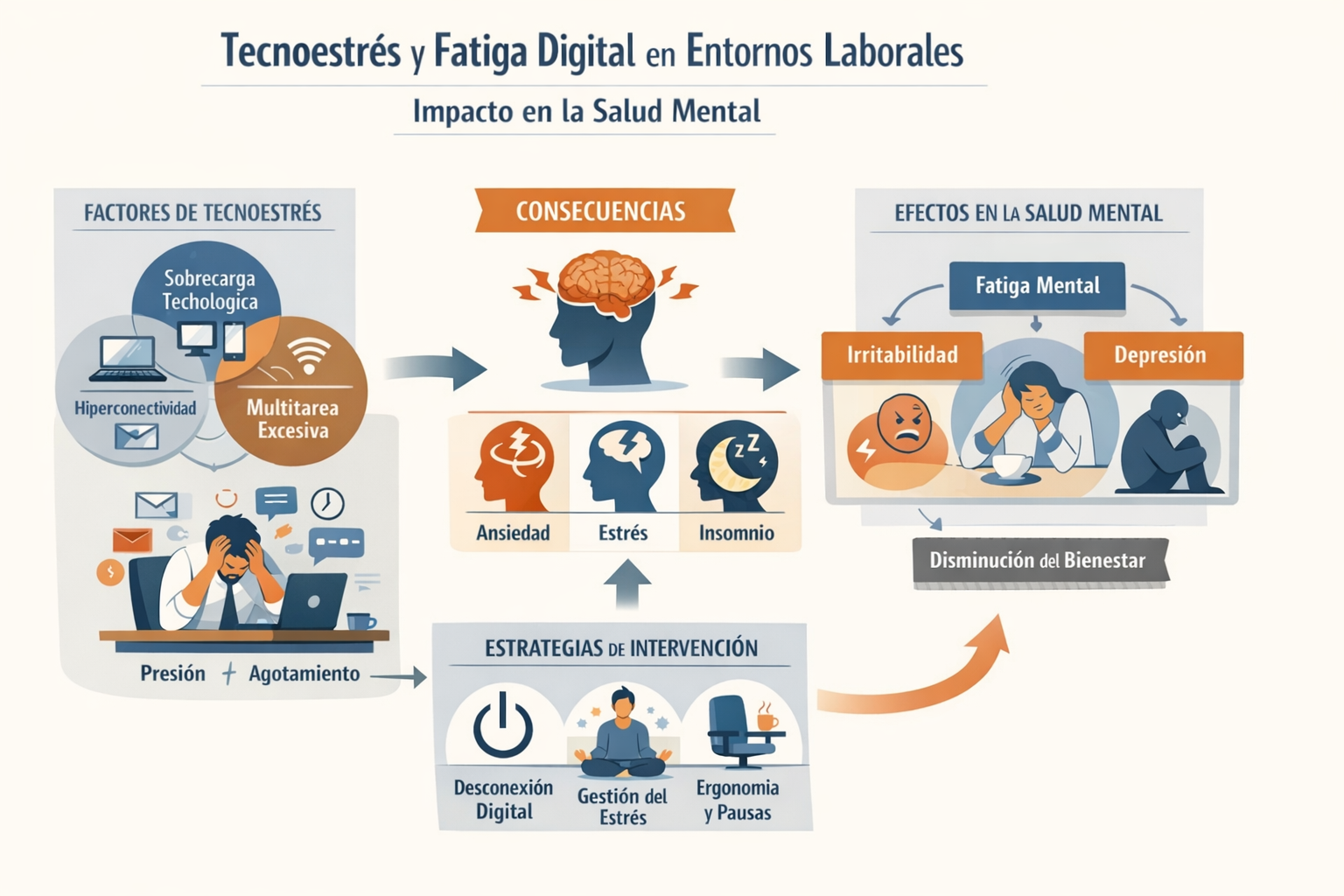
El creciente uso de tecnologías digitales en contextos laborales ha intensificado fenómenos como el tecnoestrés y la fatiga digital, con posibles implicaciones para la salud mental de los trabajadores. El presente estudio tiene como objetivo analizar la evidencia científica reciente sobre la relación entre estas variables en entornos laborales. Se realizó una revisión sistemática con síntesis narrativa basada en abstracts de la literatura siguiendo las directrices PRISMA 2020, utilizando las bases de datos Scopus, Web of Science y PubMed. Se identificaron inicialmente 1805 registros, de los cuales 41 estudios cumplieron los criterios de inclusión. Los resultados muestran una asociación frecuente entre el tecnoestrés y la fatiga digital con indicadores negativos de salud mental, incluyendo burnout, ansiedad, depresión y distrés psicológico. Asimismo, se identifican factores moderadores como la resiliencia individual, la autoeficacia digital y el apoyo organizacional. No obstante, la heterogeneidad metodológica de los estudios limita la comparación directa de resultados. Se concluye que estos fenómenos representan un riesgo emergente en el ámbito laboral, subrayando la necesidad de intervenciones organizacionales y de investigación futura con mayor rigor metodológico.
ALGUNAS CITAS
“Los resultados muestran que el impacto del tecnoestrés se articula en varios dominios interrelacionados, destacando el agotamiento emocional como desenlace central, junto con la presencia de malestar psicológico y la reducción del bienestar. Asimismo, se observa que estos efectos no se limitan al ámbito individual, sino que se extienden al funcionamiento organizacional.” (Miranda Mayo, J. J., 2026)
“En conjunto, los hallazgos sugieren que el impacto de las tecnologías en el ámbito laboral debe entenderse como un fenómeno multidimensional, en el que interactúan demandas digitales, recursos individuales y condiciones organizacionales.” (Miranda Mayo, J. J., 2026)
English
Technostress and digital fatigue in work environments: a systematic review with narrative synthesis based on abstracts of their impact on mental health
Abstract
The increasing use of digital technologies in workplace settings has intensified phenomena such as technostress and digital fatigue, with potential implications for workers’ mental health. The present study aims to analyze the recent scientific evidence on the relationship between these variables in occupational contexts. A systematic literature review was conducted following the PRISMA 2020 guidelines, using the Scopus, Web of Science, and PubMed databases. A total of 1,805 records were initially identified, of which 41 studies met the inclusion criteria. The findings indicate a consistent association between technostress and digital fatigue and negative mental health outcomes, including burnout, anxiety, depression, and psychological distress. In addition, several moderating factors were identified, such as individual resilience, digital self-efficacy, and organizational support. However, the methodological heterogeneity across studies limits the direct comparability of results. In conclusion, these phenomena represent an emerging occupational risk, highlighting the need for organizational interventions and further research with greater methodological rigor.
Keywords: Technostress; Digital fatigue; Occupational mental health; Burnout; Systematic review.
Artículo completo en: https://www.evaluacionderiesgoslaborales.com/noticia.php?idnot=54 (Revista online Evaluación de Riesgos Laborales, vol. 9, núm. 54)
Como citar el artículo en la bibliografía
Miranda Mayo, J. J. (2026). Tecnoestrés y fatiga digital en entornos laborales: una revisión sistemática con síntesis narrativa basada en abstracts de su impacto en la salud mental. Revista Evaluación de Riesgos Laborales, 9(54), 1-23, https://doi.org/10.6084/m9.figshare.31938786


Palabras clave:
Tecnoestrés; Fatiga digital; Salud mental ocupacional; Burnout; Revisión sistemáticaLicencia:
Este artículo se publica bajo la Licencia Creative Commons Atribución 4.0 Internacional (CC BY 4.0) que permite a terceros compartir la obra siempre que se indique su autor y su primera publicación en esta revista.Información de transparencia científica:
José Javier Miranda Mayo, doctorado por la UNED. Revisores del trabajo corresponden al equipo editorial de la revista Evaluación de Riesgos Laborales y a dos revisores externos independientes. El manuscrito fue sometido a una evaluación editorial preliminar para verificar su adecuación formal y el cumplimiento de las normas de la revista. Posteriormente, el contenido científico fue evaluado mediante revisión por pares doble ciego por dos revisores externos independientes.Contribución de autoría:
Salvo que en el artículo se indique expresamente una distribución diferenciada de contribuciones, todos los autores declaran haber contribuido por igual al trabajo, incluida su participación en la discusión e interpretación de los resultados y la revisión y aprobación de la versión final.
 Descargar archivo
Referencias
1. Kaltenegger, H. C., Marques, M. D., Becker, L., Rohleder, N., Nowak, D., Wright, B. J., & Weigl, M. (2024). Prospective associations of technostress at work, burnout symptoms, hair cortisol, and chronic low-grade inflammation. Brain, Behavior, and Immunity, 117, 320–329. https://doi.org/10.1016/j.bbi.2024.01.222
2. Muhamad, N. A., Ma'amor, N. H., Jamalluddin, N. H., Rosli, I. A., Leman, F. N., Shah, T. P. N. T., Misnan, N. S., Abdullah, N., Johari, M. Z., Chemi, N., & Ibrahim, N. (2025). Technostress and its associated factors: Burnout and fatigue among Malaysian healthcare workers (HCWs) in state hospitals. PLOS ONE, 20(3), e0319506. https://doi.org/10.1371/journal.pone.0319506
3. Pfluegner, K., Maier, C., & Weitzel, T. (2021). The direct and indirect influence of mindfulness on techno-stressors and job burnout: A quantitative study of white-collar workers. Computers In Human Behavior, 115, 106566. https://doi.org/10.1016/j.chb.2020.106566
4. Savolainen, I., Oksa, R., Savela, N., Celuch, M., & Oksanen, A. (2021). COVID-19 Anxiety-A Longitudinal Survey Study of Psychological and Situational Risks among Finnish Workers. International Journal of Environmental Research and Public Health, 18(2), 794. https://doi.org/10.3390/ijerph18020794
5. Meidina, D. W., & S., N. L. (2022). The influence of employee mental health on performance mediated by workplace well-being (Empirical study on information technology division employees during work from home period). Business Management Journal, 18(1), 85. https://doi.org/10.30813/bmj.v18i1.3092
6. Do, H. R., & Lee, B. C. (2020). The effects of tourism industry employees’ technostress on burnout, organizational conflict and job performance. Event & Convention Research, 16(4), 135–150. https://doi.org/10.31927/asec.16.4.8
7. Darmawan, B. P., Arfani, M., Ayuningtiyas, G. A., & Priyanto. (2026). The effect of technostress on employee performance: The mediating role of anxiety among generation Z in the creative industry. International Journal of Integrative Sciences, 5(2), 323–334. https://doi.org/10.55927/ijis.v5i2.5
8. Ali, F., Nisar, Q. A., & Nasir, S. (2023). Do emotions matter in digitized workplace? Technostress and employees' emotional well-being during the pandemic. Kybernetes, 52(12), 6122–6143. https://doi.org/10.1108/K-10-2021-1000
9. Thurik, R., Benzari, A., Fisch, C., Mukerjee, J., & Torres, O. (2024). Techno-overload and well-being of French small business owners: identifying the flipside of digital technologies. Entrepreneurship And Regional Development, 36(1-2), 136–161. https://doi.org/10.1080/08985626.2023.2165713
10. Penalver, J., & Diaz-Mena, S. (2023). Teachers under lockdown: a preliminary study on job crafting behaviors to reduce techno-stress. Aloma: Revista de Psicologia, Ciències de l’Educació i de l’Esport, 41(1), 103–109. https://doi.org/10.51698/aloma.2023.41.1.103-109
11. Huvanandana, G., & Charoensukmongkol, P. (2026). How digital leadership and innovative climate interact to lessen AI-related job insecurity, AI use anxiety, technostress, and emotional exhaustion. International Journal Of Workplace Health Management, 19(2), 189–206. https://doi.org/10.1108/IJWHM-09-2025-0252
12. Mahapatra, M., & Ford, D. P. (2024). Technostress and disengagement from knowledge sharing: insights from pre-pandemic and mid-pandemic data sets. Journal Of Knowledge Management. https://doi.org/10.1108/JKM-08-2023-0711
13. Dutta, D., & Mishra, S. K. (2024). Technology is killing me!: the moderating effect of organization home-work interface on the linkage between technostress and stress at work. Information Technology & People, 37(6), 2203–2222. https://doi.org/10.1108/ITP-03-2022-0169
14. Oksanen, A., Oksa, R., Celuch, M., Cvetkovic, A., & Savolainen, I. (2023). COVID-19 Anxiety and Wellbeing at Work in Finland during 2020-2022: A 5-Wave Longitudinal Survey Study. International Journal of Environmental Research and Public Health, 20(1), 680. https://doi.org/10.3390/ijerph20010680
15. Hurbean, L., Dospinescu, O., Munteanu, V., & Danaiata, D. (2022). Effects of Instant Messaging Related Technostress on Work Performance and Well-Being. Electronics, 11(16), 2535. https://doi.org/10.3390/electronics11162535
16. Semaan, R., Gamaiunova, L., Teixeira, P. P., Nater, U. M., Heinzer, R., Haba-Rubio, J., Vlerick, P., Cambier, R., & Gomez, P. (2025). Psychometric properties of telepressure measures in the workplace and private life among French-speaking employees. BMC Psychology, 13(1), 329. https://doi.org/10.1186/s40359-025-02616-0
17. Ficapal-Cusi, P., Penarroja, V., Enache-Zegheru, M., & Salazar-Concha, C. (2025). Employee Technostress: Analyzing the Influence of Sociodemographic Characteristics on Techno-Stressors and Their Consequences. International Journal Of Human-Computer Interaction, 41(2), 1309–1322. https://doi.org/10.1080/10447318.2024.2313926
18. Kraeft, J., Wirth, T., Harth, V., & Mache, S. (2024). Digital stress perception among German hospital nurses and associations with health-oriented leadership, emotional exhaustion and work-privacy conflict: a cross-sectional study. BMC Nursing, 23(1), 213. https://doi.org/10.1186/s12912-024-01825-z
19. Sadaf, S., Khanam, A., & Zamir, M. N. (2025). Does technostress undermine employees' work-life balance? Testing the moderated-mediation effects of employee resilience and psychological distress. Asia-Pacific Journal Of Business Administration. https://doi.org/10.1108/APJBA-08-2024-0447
20. Marchiori, D. M., Mainardes, E. W., & Rodrigues, R. G. (2019). Do Individual Characteristics Influence the Types of Technostress Reported by Workers? International Journal Of Human-Computer Interaction, 35(3), 218–230. https://doi.org/10.1080/10447318.2018.1449713
21. Ma, J., Ollier-Malaterre, A., & Lu, C.-Q. (2021). The impact of techno-stressors on work-life balance: The moderation of job self-efficacy and the mediation of emotional exhaustion. Computers In Human Behavior, 122, 106811. https://doi.org/10.1016/j.chb.2021.106811
22. Ali, K. T. M., & Sivasubramanian, R. C. (2024). Understanding the Nexus Between Techno-Stress, Psychological Well-Being, and the Moderating Role of Job Resources in the Gig Economy. Employee Responsibilities And Rights Journal. https://doi.org/10.1007/s10672-024-09505-5
23. Shamout, M. D., Elayan, M. B. H., Hamouche, S., Rawashdeh, A. M., & Elrehail, H. (2022). Impact of Technostress on Withdrawal Behavior and Workplace Flourishing: Do Contextual Variables Matter? Information Resources Management Journal, 35(1). https://doi.org/10.4018/IRMJ.312212
24. Kiersztyn, A., Galka, L., Wojciechowska, K., Kiersztyn, K., Rzepka, A., Jonak, K., & Karczmarek, P. (2025). Money cannot buy happiness: Emotions in the IT industry. IEEE Transactions on Fuzzy Systems, 33(9), 2884–2898. https://doi.org/10.1109/TFUZZ.2025.3575524
25. Provenzano, M., Cillara, N., Curcio, F., Pisu, M. O., Gonzalez, C. I. A., & Jimenez-Herrera, M. F. (2024). Electronic Health Record Adoption and Its Effects on Healthcare Staff: A Qualitative Study of Well-Being and Workplace Stress. International Journal of Environmental Research and Public Health, 21(11). https://doi.org/10.3390/ijerph21111430
26. Patel, T., Jhaveri, R. H., & Bvuma, S. (2025). Analyzing the Impact of Digital Transformation on Mental Health of IT Professionals Using Machine Learning Methods. 2025 International Conference on Artificial Intelligence and Machine Vision, AIMV 2025. https://doi.org/10.1109/AIMV66517.2025.11203345
27. Simbula, S., Paganin, G., & Molino, M. (2024). Videoconference fatigue: validation of the Italian translated Zoom Exhaustion and Fatigue Scale (ZEFS). Fatigue: Biomedicine, Health & Behavior, 12(1), 43–57. https://doi.org/10.1080/21641846.2023.2290137
28. Simon, A. C., Pachner, O. C., & Kiss, O. E. (2024). Digital challenges: The emergence of technostress and its relationship with organizational psychosocial factors among Hungarian office workers. Magyar Pszichológiai Szemle, 79(4), 757–776. https://doi.org/10.1556/0016.2024.00097
29. Marrinhas, D., Santos, V., Salvado, C., Pedrosa, D., & Pereira, A. (2023). Burnout and technostress during the COVID-19 pandemic: the perception of higher education teachers and researchers. Frontiers In Education, 8, 1144220. https://doi.org/10.3389/feduc.2023.1144220
30. Bail, C., Harth, V., & Mache, S. (2023). Digitalization in Urology-A Multimethod Study of the Relationships between Physicians' Technostress, Burnout, Work Engagement and Job Satisfaction. Healthcare, 11(16), 2255. https://doi.org/10.3390/healthcare11162255
31. Pagan-Garbin, I., Mendez, I., & Martinez-Ramon, J. P. (2024). Exploration of stress, burnout and technostress levels in teachers. Prediction of their resilience levels using an artificial neuronal network (ANN). Teaching And Teacher Education, 148, 104717. https://doi.org/10.1016/j.tate.2024.104717
32. Wuertenberger, A., Groneberg, D. A., & Mache, S. (2025). Digital stress perception and associations with work- and health-related outcomes among general practitioners in Germany: a quantitative study. BMC Health Services Research, 25(1), 535. https://doi.org/10.1186/s12913-025-12653-5
33. Toker, S., Uzun, S., Emirza, E. G., & Guven, E. (2026). In the Shadow of Digital Burnout: A Qualitative Study on Academic Nurses' Perspectives on Digital Fatigue and Mental Health. Journal Of Nursing Scholarship, 58(2), e70070. https://doi.org/10.1111/jnu.70070
34. Kopuz, K., Turgut, M., & Aydin, G. (2025). Technostress among nurses: boon or bane? The moderated mediation model. BMC Nursing, 24(1), 1092. https://doi.org/10.1186/s12912-025-03721-6
35. Wirth, T., Kraeft, J., Marquardt, B., Harth, V., & Mache, S. (2024). Indicators of technostress, their association with burnout and the moderating role of support offers among nurses in German hospitals: a cross-sectional study. BMJ Open, 14(7), 1–12. https://doi.org/10.1136/bmjopen-2024-085705
36. Golz, C., Peter, K. A., Mueller, T. J., Mutschler, J., Zwakhalen, S. M. G., & Hahn, S. (2021). Technostress and Digital Competence Among Health Professionals in Swiss Psychiatric Hospitals: Cross-sectional Study. JMIR Mental Health, 8(11), e31408. https://doi.org/10.2196/31408
37. Bahr, T. J., Ginsburg, S., Wright, J. G., & Shachak, A. (2023). Technostress as source of physician burnout: An exploration of the associations between technology usage and physician burnout. International Journal Of Medical Informatics, 177, 105147. https://doi.org/10.1016/j.ijmedinf.2023.105147
38. Bernburg, M., Gebhardt, J. S., Groneberg, D. A., & Mache, S. (2025). Impact of Digitalization in Dentistry on Technostress, Mental Health, and Job Satisfaction: A Quantitative Study. Healthcare, 13(1), 72. https://doi.org/10.3390/healthcare13010072
39. Veiga, M. G., Felizi, R. T., Trevisan, G. D., Cubero, D. D. I. G., Fernandes, C. E., & De Oliveira, E. (2022). Message applications in the doctor-patient relationship as a stressor. Revista Da Associacao Medica Brasileira, 68(9), 1228–1233. https://doi.org/10.1590/1806-9282.20220253
40. Wang, Q., & Yao, N. (2025). Understanding the impact of technology usage at work on academics' psychological well-being: a perspective of technostress. BMC Psychology, 13(1), 130. https://doi.org/10.1186/s40359-025-02461-1
41. Bakhai, A., McCauley, L., Stones, L., Khalil, S., Mehta, J., Price, N., Krishnamurthy, V., Parker, L. H. H., & Hughes, D. (2022). Shining a light on an additional clinical burden: work-related digital communication survey study - COVID-19 impact on NHS staff wellbeing. Humanities & Social Sciences Communications, 9(1), 414. https://doi.org/10.1057/s41599-022-01427-7
ESTADISTICAS
Total desde publicación y últimos 5 años
Últimas noticias
Programa de control de infecciones (PCI) en el Centro hospitalario de Sucre CEHOSRiesgos psicosociales en la interpretación de enlace en contextos de atención psicológica: un estudio exploratorio con intérpretes profesionalesAcciones de mejora para el fortalecimiento del sistema de gestión de seguridad y salud en el trabajo en una Institución de educación básica con modalidad de educación media técnica industrial en Cartagena, ColombiaGestión de alergias alimentarias en aviación comercial: revisión narrativa crítica y análisis de la coherencia entre evidencia científica y práctica operativaVigilancia de la influenza y otras infecciones respiratorias en entornos ocupacionales y congregados: análisis bibliométrico y síntesis para sistemas de vigilancia y continuidad operativaSugiera noticiasSIN COMPROMISO